L12 Mixed Q1 · Same bits on two computers
Training checkpoints across CPUs and instruction sets
QuestionIf you run the same training job with the same seed on two computers, do you get the same model?
Run by us; no unaffiliated reproduction
The test in one picture
Question, method, result and meaning, in plain words. The sourced detail is further down the page.
The same picture, in words
- Question
- If you run the same training job with the same seed on two computers, do you get the same model?
- Why it matters
- If the same training job gives different checkpoint bytes on different computers, a trained model cannot be reproduced from its recipe.
- How the test works
- Train a tiny language model with a fixed seed; hash the raw parameter bytes at steps 50, 100, 150, 200.
- Run default PyTorch on a CPU with AVX2 and one without.
- Run PyTorch again with the CPU kernel and thread count pinned.
- Run a from-scratch fixed-order C trainer (13,088 parameters) on five hosts.
- What we found
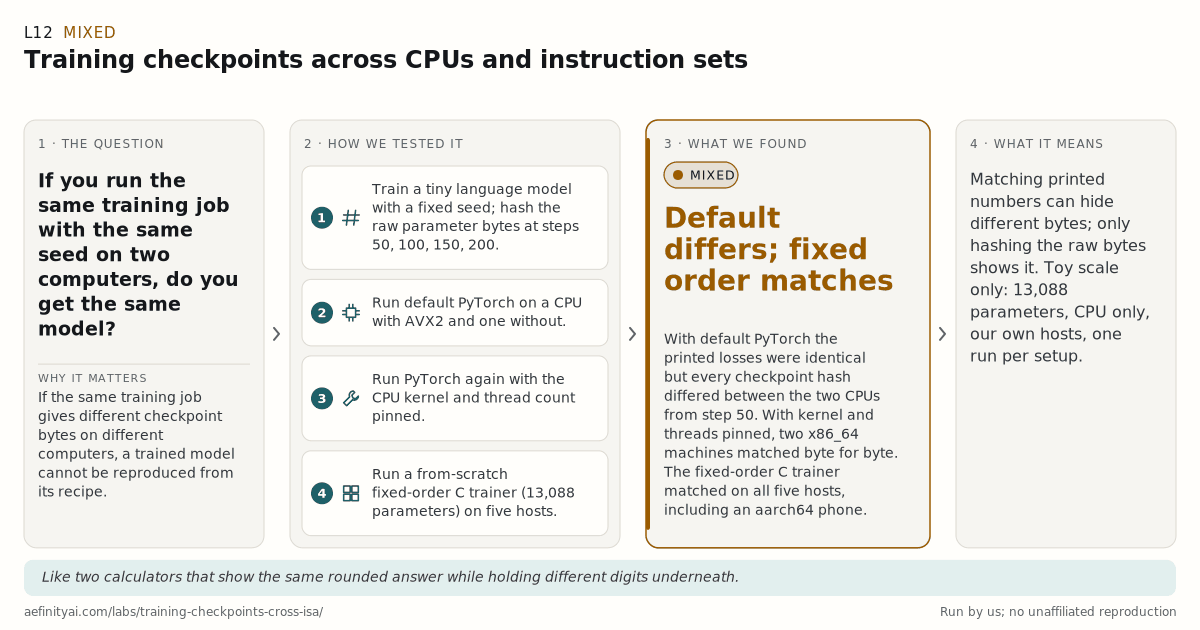
- Default differs; fixed order matches. With default PyTorch the printed losses were identical but every checkpoint hash differed between the two CPUs from step 50. With kernel and threads pinned, two x86_64 machines matched byte for byte. The fixed-order C trainer matched on all five hosts, including an aarch64 phone.
- What it means
- Matching printed numbers can hide different bytes; only hashing the raw bytes shows it. Toy scale only: 13,088 parameters, CPU only, our own hosts, one run per setup.
- Everyday comparison
- Like two calculators that show the same rounded answer while holding different digits underneath.
- Where the facts come from
Share this picture: SVG · PNG (1200 x 630)

01Why it matters
If the same training job gives different checkpoint bytes on different computers, a trained model cannot be reproduced from its recipe.
02Method, step by step
- Train a tiny language model with a fixed seed and corpus; hash the raw parameter bytes at steps 50, 100, 150 and 200.
- Run default PyTorch on an AVX2 CPU and a no-AVX2 CPU.
- Run PyTorch again with the CPU kernel and thread count pinned.
- Run a from-scratch fixed-order C trainer (13,088 parameters) on five hosts.
Method as recorded
A tiny language-model trainer, checkpoints at steps 50, 100, 150 and 200 hashed (sha256) over raw parameter bytes, same seed and synthetic corpus in every run. Three variants: default PyTorch (torch 2.14.0+cpu) on an AVX2/FMA CPU (Intel i5-5200U) and a no-AVX2 CPU (Intel Celeron N4020); the same PyTorch script with the CPU kernel pinned (ATEN_CPU_CAPABILITY=default, MKL_CBWR=COMPATIBLE, single-threaded) on the same two machines; and a from-scratch fixed-order fp32 C trainer (byte-level MLP, 13,088 parameters, 200 steps) on five hosts: three x86_64 without AVX2, one x86_64 with AVX2/FMA, and one aarch64 phone. Run by us.
03Results, exact and sourced
-
R1Default PyTorch: the printed losses were identical, but every checkpoint hash differed between the two CPUs from step 50. Same-machine reruns matched on each host. The source calls the cause (different vectorized kernel path) 'consistent with', not demonstrated.
**MISMATCH.** The four printed loss scalars are bit-identical (same Python `repr()` at every checkpoint on both hosts), but all four checkpoint sha256 digests differ, starting at the first recorded checkpoint (step 50).
Verbatim source cis2-spec / 2026-09-24-CROSS-ISA-TRAINING-RECEIPT.md -
R2Pinned PyTorch (kernel dispatch and thread count pinned) gave byte-identical checkpoints on the same two x86_64 machines; the source says this is not a cross-ISA result.
**MATCH — cross-machine, not cross-ISA.**
Verbatim source cis2-spec / 2026-09-24-CROSS-ISA-TRAINING-RECEIPT.md -
R3The fixed-order C trainer gave identical checkpoint hashes on all five hosts, including one aarch64 phone; a second clean build on one x86_64 host and the phone reproduced the same digests.
All four checkpoint sha256 digests are identical across all five hosts: three x86_64 machines without AVX2, one x86_64 machine with AVX2/FMA, and one aarch64 machine — a cross-ISA result.
Verbatim source cis2-spec / 2026-09-24-CROSS-ISA-TRAINING-RECEIPT.md
04What it does NOT show
Large models, GPUs, or any general guarantee. Each result is an observed outcome for one configuration on our own hosts.
05Scope and caveats
- Toy scale: the C trainer has 13,088 fp32 parameters and runs 200 steps; no claim about large models or step counts.
- The C trainer is a different architecture (byte-level MLP) from the PyTorch runs; no numeric parity between them is claimed.
- CPU only; no GPU host was tested.
- The C trainer source is not released.
- One run per configuration; the cross-ISA result rests on a single aarch64 device.
- The source pins no general guarantee: each result is an observed outcome for its specific configuration and host set.
- No timing figures are reported (identity/correctness experiment only).
- Our own hosts only. Run by us; no unaffiliated reproduction.
06Outcome
Some parts held, some did not, or we corrected ourselves.
07What we learned
Identical printed loss numbers hid different checkpoint bytes; only hashing the raw bytes revealed it. Pinning the kernel made two x86_64 machines agree, and a fixed-order trainer gave identical bytes across instruction sets, shown so far only at toy scale on our own hosts.
08Check it yourself
- cis2-spec / 2026-09-24-CROSS-ISA-TRAINING-RECEIPT.mdhttps://github.com/Aefinity-AI/cis2-spec/blob/main/docs/results/2026-09-24-CROSS-ISA-TRAINING-RECEIPT.md
Read the result page. The C trainer source is not released.