L08 Mixed Q4 · Agent records and their cost
Receipt-verified agent evaluation, and the hole we found in our own verifier
QuestionIf every test item needs a verified receipt, can someone pass off a genuine receipt under the wrong item?
Archived research (2026-10), development paused. This lab belongs to the CIS-2 line of research.
Run by us; no unaffiliated reproduction
The test in one picture
Question, method, result and meaning, in plain words. The sourced detail is further down the page.
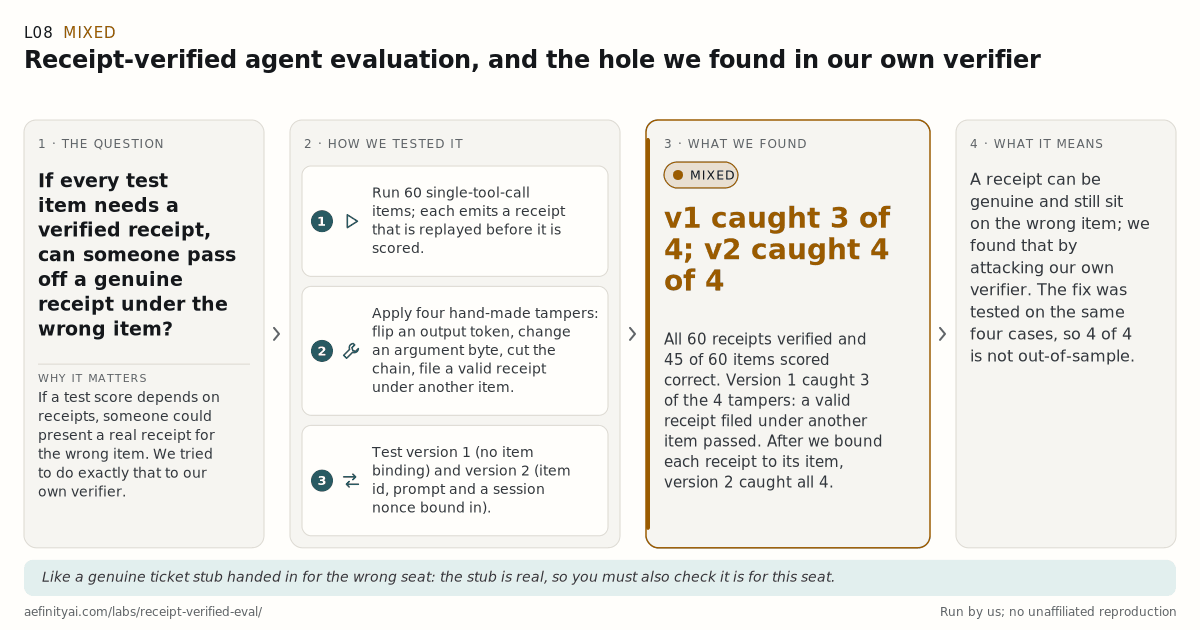
The same picture, in words
- Question
- If every test item needs a verified receipt, can someone pass off a genuine receipt under the wrong item?
- Why it matters
- If a test score depends on receipts, someone could present a real receipt for the wrong item. We tried to do exactly that to our own verifier.
- How the test works
- Run 60 single-tool-call items; each emits a receipt that is replayed before it is scored.
- Apply four hand-made tampers: flip an output token, change an argument byte, cut the chain, file a valid receipt under another item.
- Test version 1 (no item binding) and version 2 (item id, prompt and a session nonce bound in).
- What we found
- v1 caught 3 of 4; v2 caught 4 of 4. All 60 receipts verified and 45 of 60 items scored correct. Version 1 caught 3 of the 4 tampers: a valid receipt filed under another item passed. After we bound each receipt to its item, version 2 caught all 4.
- What it means
- A receipt can be genuine and still sit on the wrong item; we found that by attacking our own verifier. The fix was tested on the same four cases, so 4 of 4 is not out-of-sample.
- Everyday comparison
- Like a genuine ticket stub handed in for the wrong seat: the stub is real, so you must also check it is for this seat.
- Where the facts come from
Share this picture: SVG · PNG (1200 x 630)

01Why it matters
If a test score depends on receipts, someone could present a real receipt for the wrong test item. We tried to do exactly that to our own verifier.
02Method, step by step
- Run 60 single-tool-call items; each emits a receipt that is replayed against pinned artifacts before it is scored.
- Apply four hand-made tampers: flip an output token, change a tool-argument byte, truncate the chain by one step, file a valid receipt under another item.
- Check version 1 (no item binding) and version 2 (item id, prompt and a session nonce folded into the start of the chain).
Method as recorded
60-item single-tool-call suite (template T1), pruned BitNet-2B, one host (one of our own machines). Every item emits an agent_trace receipt that is replayed against pinned model/embed/vocab artifacts before the item is scored. One hand-made tamper was applied to each of four items: flip an output token, change a tool-arg byte, truncate the chain by one step, and replay a valid receipt under a different item's filename. v1 receipts have no context binding. v2 folds item-ctx = sha256(item_id || prompt_bytes || session_nonce) into the trace genesis. Run by us.
03Results, exact and sourced
-
R1All 60 receipts verified.
| Receipt verification | 60/60 PASS |
Verbatim source cis2-spec / 2026-09-13-RECEIPT-VERIFIED-EVAL60.md -
R2Task score on receipt-verified outputs.
| Score (receipt-verified outputs, arg_match AND output_match) | 45/60 |
Verbatim source cis2-spec / 2026-09-13-RECEIPT-VERIFIED-EVAL60.md -
R3v1 caught 3 of 4 tampers; after context binding, v2 caught all 4.
Overall: v1 = 57/60 PASS, **3/4 tampers caught**. v2 = 56/60 PASS, **4/4 tampers caught**.
Verbatim source cis2-spec / 2026-09-13-RECEIPT-VERIFIED-EVAL60.md -
R4The v1 miss: a valid receipt filed under another item's name (lookup_hit_01) verified like a genuine one.
**PASS (not caught)**
Verbatim source cis2-spec / 2026-09-13-RECEIPT-VERIFIED-EVAL60.md
04What it does NOT show
Out-of-sample protection: the fix was tested on the same four cases that exposed the hole. One host, one model and one template. The 45 of 60 is a task score, not a benchmark.
05Scope and caveats
- Four hand-made tampers, not adversarially optimized or randomly sampled; the v2 fix was tested on the same four cases that exposed the hole, so 4/4 is not out-of-sample.
- Template T1 only (calculator, lookup, mixed single tool-call turns); one pruned BitNet-2B model; a single host (one of our own machines) generated all receipts, so there is no cross-machine claim.
- The 45/60 score is a task score on receipt-verified outputs and is not a benchmark. The source reports no timing figures.
- The fix lives on branch cm/safe2c-ctx-binding (commit 13ed3c47ae5a), and the source says it was not yet merged into alice-aegis main.
- Run by us; no unaffiliated reproduction.
06Outcome
Some parts held, some did not, or we corrected ourselves.
07What we learned
A receipt can verify and still be filed on the wrong item. We found that by trying to break our own verifier, and binding each receipt to its item closed the case we found.
08Check it yourself
- cis2-spec / 2026-09-13-RECEIPT-VERIFIED-EVAL60.mdhttps://github.com/Aefinity-AI/cis2-spec/blob/main/docs/results/2026-09-13-RECEIPT-VERIFIED-EVAL60.md
- alice-aegis / commit 13ed3c4https://github.com/Aefinity-AI/alice-aegis/commit/13ed3c47ae5a
Read the result page and the fix commit. The source says the fix was on a branch not yet merged into main.