L17 Mixed Q6 · Do our tests test anything
E27: exp, ln and SiLU on every float32 input, and a defect in our spec
QuestionIs the pinned exponential accurate on every possible input, and are the spec's safety guards correct?
Run by us; no unaffiliated reproduction
The test in one picture
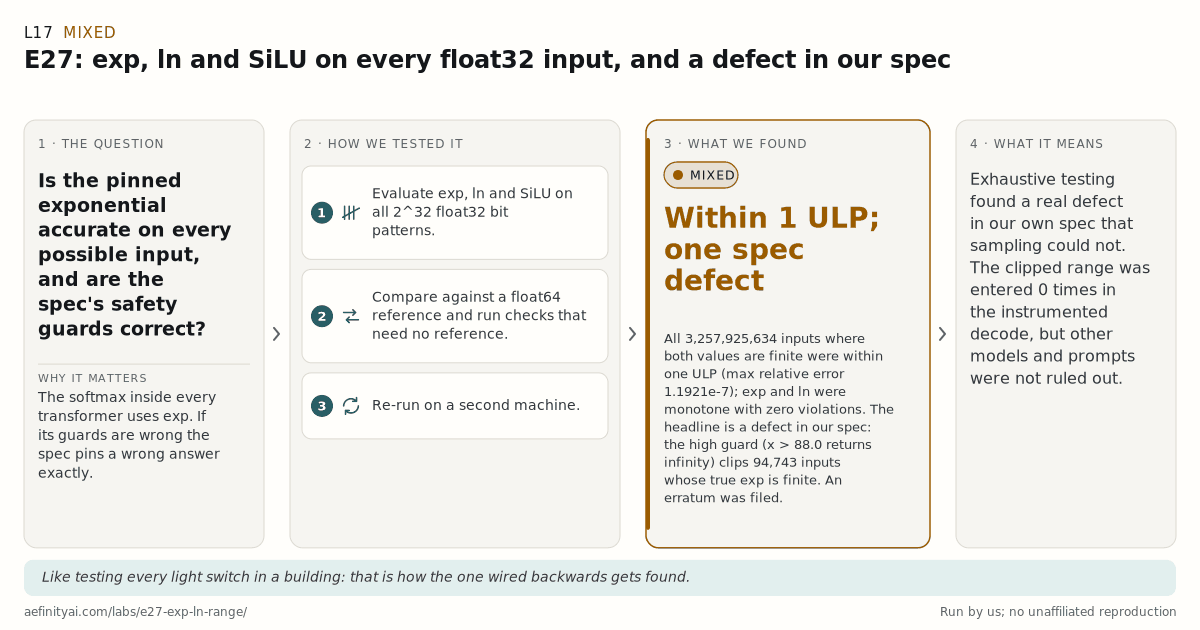
Question, method, result and meaning, in plain words. The sourced detail is further down the page.
The same picture, in words
- Question
- Is the pinned exponential accurate on every possible input, and are the spec's safety guards correct?
- Why it matters
- The softmax inside every transformer uses exp. If its guards are wrong the spec pins a wrong answer exactly.
- How the test works
- Evaluate exp, ln and SiLU on all 2^32 float32 bit patterns.
- Compare against a float64 reference and run checks that need no reference.
- Re-run on a second machine.
- What we found
- Within 1 ULP; one spec defect. All 3,257,925,634 inputs where both values are finite were within one ULP (max relative error 1.1921e-7); exp and ln were monotone with zero violations. The headline is a defect in our spec: the high guard (x > 88.0 returns infinity) clips 94,743 inputs whose true exp is finite. An erratum was filed.
- What it means
- Exhaustive testing found a real defect in our own spec that sampling could not. The clipped range was entered 0 times in the instrumented decode, but other models and prompts were not ruled out.
- Everyday comparison
- Like testing every light switch in a building: that is how the one wired backwards gets found.
- Where the facts come from
Share this picture: SVG · PNG (1200 x 630)

01Why it matters
The softmax inside every transformer uses exp. If its guards are wrong the spec pins a wrong answer exactly.
02Method, step by step
- Evaluate exp, ln and SiLU on all 2^32 float32 bit patterns.
- Compare against a float64 reference and run oracle-free monotonicity checks.
- Re-run on a second machine.
Method as recorded
Every one of the 2^32 f32 bit patterns evaluated for exp_pinned, ln_pinned and silu_pinned under the pinned environment (FTZ/DAZ, 8 worker threads) against a host glibc float64 oracle narrowed to f32 and flushed, plus oracle-free monotonicity checks. Run by us on one machine (an x86_64 VM); the same binary was re-run by us on a second machine (Celeron, no AVX2, same glibc) with a byte-identical log.
03Results, exact and sourced
-
R1Every one of the 3,257,925,634 arguments where both the pinned exp and the oracle are finite is within one ULP (max relative error 1.1921e-7 = 2^-23), measured against a float64 oracle.
Every one of the 3,257,925,634 arguments for which both `exp_pinned` and the oracle are finite is within **one ULP**.
Verbatim source cis2-spec / E27_EXP_LN_RANGE.md -
R2Defect in our own spec: the high guard (x > 88.0 returns +Infinity) clips 94,743 arguments (0x42B00001 to 0x42B17217) whose true exp is finite and representable in f32. Behaviour is pinned as normative and unchanged; an erratum was filed.
§6.2's high guard clips 94,743 values below the representable range
Verbatim source cis2-spec / E27_EXP_LN_RANGE.md -
R3exp and ln were monotone over the whole finite domain (zero violations), an oracle-free check.
exp monotone: violations=0
Verbatim source cis2-spec / E27_EXP_LN_RANGE.md
04What it does NOT show
Correct rounding, a second compiler or libm, or that the defective range is reachable by other models or prompts (it was entered 0 times in the instrumented decode).
05Scope and caveats
- Accuracy is against a float64 oracle (host glibc exp narrowed to f32), not correct rounding; where narrowing double-rounds the oracle itself may differ from the correctly rounded f32.
- The headline is the guard defect, not the accuracy.
- The source states the second-machine re-run used the same binary and same glibc, so it does not test a second compiler or libm.
- The clip band was entered 0 times in an instrumented decode (one model, six ASCII prompts, at most 64 tokens); no claim that other models or prompts cannot reach it.
- Two-ULP silu figure is for the function in isolation, not accumulated through an FFN.
- The source says an earlier draft's FTZ reasoning about the silu discontinuity was wrong; E39 (CHANGELOG ERRATUM E-12) later corrected neighbouring FTZ reasoning.
- Run by us; no unaffiliated reproduction.
06Outcome
Some parts held, some did not, or we corrected ourselves.
07What we learned
The accuracy was the unremarkable part. Exhaustive testing found a real defect in our own spec that sampled tests could not, and we recorded it in the open.
08Check it yourself
- cis2-spec / E27_EXP_LN_RANGE.mdhttps://github.com/Aefinity-AI/cis2-spec/blob/main/docs/E27_EXP_LN_RANGE.md
Read the page (link above).