L05 Mixed Q6 · Do our tests test anything
Sin/cos accuracy for RoPE against a pre-registered 2 ULP bar (v0.2, v0.3, v0.3b)
QuestionIs the pinned sin/cos accurate enough for long contexts, measured against a bar we set before we tested?
Run by us; no unaffiliated reproduction
The test in one picture
Question, method, result and meaning, in plain words. The sourced detail is further down the page.
The same picture, in words
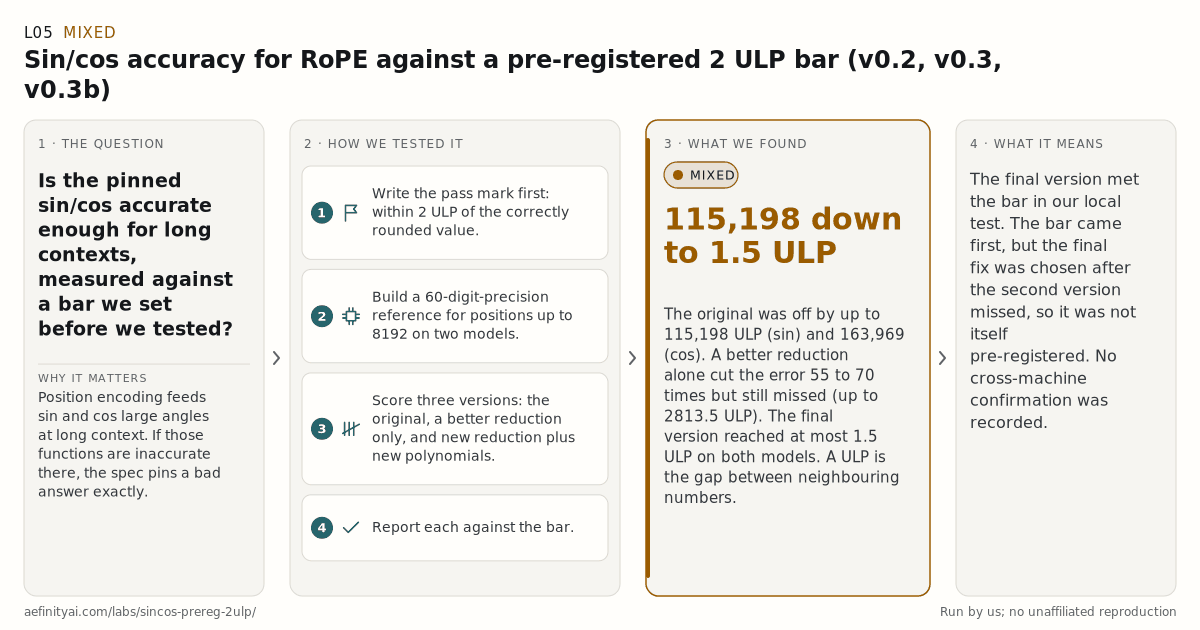
- Question
- Is the pinned sin/cos accurate enough for long contexts, measured against a bar we set before we tested?
- Why it matters
- Position encoding feeds sin and cos large angles at long context. If those functions are inaccurate there, the spec pins a bad answer exactly.
- How the test works
- Write the pass mark first: within 2 ULP of the correctly rounded value.
- Build a 60-digit-precision reference for positions up to 8192 on two models.
- Score three versions: the original, a better reduction only, and new reduction plus new polynomials.
- Report each against the bar.
- What we found
- 115,198 down to 1.5 ULP. The original was off by up to 115,198 ULP (sin) and 163,969 (cos). A better reduction alone cut the error 55 to 70 times but still missed (up to 2813.5 ULP). The final version reached at most 1.5 ULP on both models. A ULP is the gap between neighbouring numbers.
- What it means
- The final version met the bar in our local test. The bar came first, but the final fix was chosen after the second version missed, so it was not itself pre-registered. No cross-machine confirmation was recorded.
- Where the facts come from
Share this picture: SVG · PNG (1200 x 630)

01Why it matters
Rotary position encoding feeds sin and cos with large angles at long context. If the pinned functions are inaccurate there, the spec pins a bad answer exactly.
02Method, step by step
- Write the pass mark down first: within 2 ULP of the correctly rounded f32 value.
- Build a 60-digit-precision reference (mpmath) for the angles up to position 8192 on two models.
- Score three versions: the original, a version with a higher-precision reduction only, and a version with octant reduction plus new polynomials.
- Report each against the bar.
Method as recorded
A pre-registration set a 2 ULP bar (oracle within 2 ULP of correctly-rounded f32) before the v0.3 fix was implemented. An mpmath 60-digit oracle covered RoPE angles for positions up to max_position_embeddings=8192, using the SmolLM2-135M (theta=1e5) and Qwen2.5-0.5B (theta=1e6) values. It compared three versions of the sin/cos reduction. The v0.3b mechanism was added by a coordinator directive after v0.3 missed the bar. Local x86_64 sandbox harness (scripts/h2m_accuracy_harness.py). Run by us.
03Results, exact and sourced
v0.2 sin: 115198 ULP; v0.2 cos: 163969 ULP; v0.3 (max): 2813.5 ULP; v0.3b sin: 1.5 ULP; v0.3b cos: 1.5 ULP; bar: 2 ULP
The values come from different local runs (v0.2 from the oracle run, v0.3b from the harness run, v0.3 as raw ULP), so the bars are not a like-for-like comparison. v0.3b meets the bar; v0.2 and v0.3 do not. Figure drawn from the sourced results below.
-
R1The pre-registration was written before implementation.
**Status: pre-registered before implementation.**
Verbatim source cis2-spec / E15m_PREREG.md -
R2v0.2 (f32-only reduction, Taylor polynomial) had errors up to 115198 ULP for sin and up to 163969 ULP for cos, in the local oracle run.
| v0.2 (f32-only reduce, Taylor) | up to 115198 | 1.30e-2 | up to 163969 | 1.36e-2 |
Verbatim source cis2-spec / E15m_RESULT.md -
R3v0.3 (f64-staged reduction only) cut the error by roughly 55 to 70 times, with a max of 2813.5 raw ULP, and still missed the 2 ULP bar. The doc attributes the residual to the unchanged Taylor polynomial.
"<=2 ULP" bar is NOT met
Verbatim source cis2-spec / E15m_RESULT.md -
R4v0.3b (octant reduction plus separate minimax polynomials) reached a maximum of 1.5 ULP for sin and cos on both models and met the bar, in the local harness run.
| **v0.3b (octant reduce, minimax)** | **1.5** | **1.2e-7** | **1.5** | **1.2e-7** |
Verbatim source cis2-spec / E15m_RESULT.md
04What it does NOT show
Cross-ISA or CI confirmation (pending when written), positions above 8192, or that the final mechanism was pre-registered. It was added after the second version missed.
05Scope and caveats
- Local x86_64 sandbox harness numbers only. CI runs were dispatched but were still in flight when the document was written, and the doc records no CI confirmation. Cross-ISA (aarch64) confirmation was pending.
- Positions 0 to 8192 only. The v0.3b run used a dense grid (stride 7, plus positions 0 to 19 and the last position), not every position.
- The 2 ULP bar was pre-registered for the v0.3 mechanism. The v0.3b mechanism was chosen after v0.3 missed, so it was not itself pre-registered.
- The doc says the v0.3 ULP counts are inflated near sin/cos zero-crossings, a known property of the ULP metric. The v0.3 filtered figure (values with |sin/cos| >= 1e-2) is up to 486.5 ULP.
- The work sits on branch cm/e15m-spec-v0.3-rope with 'Do NOT merge to main pending review'. The doc is on main, but the branch URL returns 404 unauthenticated, so the branch work is not public.
- Gate (3), the token-match oracle runs, was not re-run for v0.3b in that pass.
- Run by us; no unaffiliated reproduction.
06Outcome
Some parts held, some did not, or we corrected ourselves.
07What we learned
Fixing only the reduction improved the error a lot and still failed the bar, because the polynomial was now the dominant error. We kept the bar and changed both the reduction and the polynomials, which met it in the local harness.
08Check it yourself
- cis2-spec / E15m_RESULT.mdhttps://github.com/Aefinity-AI/cis2-spec/blob/main/docs/E15m_RESULT.md
- cis2-spec / E15m_PREREG.mdhttps://github.com/Aefinity-AI/cis2-spec/blob/main/docs/E15m_PREREG.md
Read the pre-registration and the result page (links above). The branch the work sits on is not public.