L33 Undated in the source Negative Q9 · Shrinking models
Claims from the literature that failed when we ran them
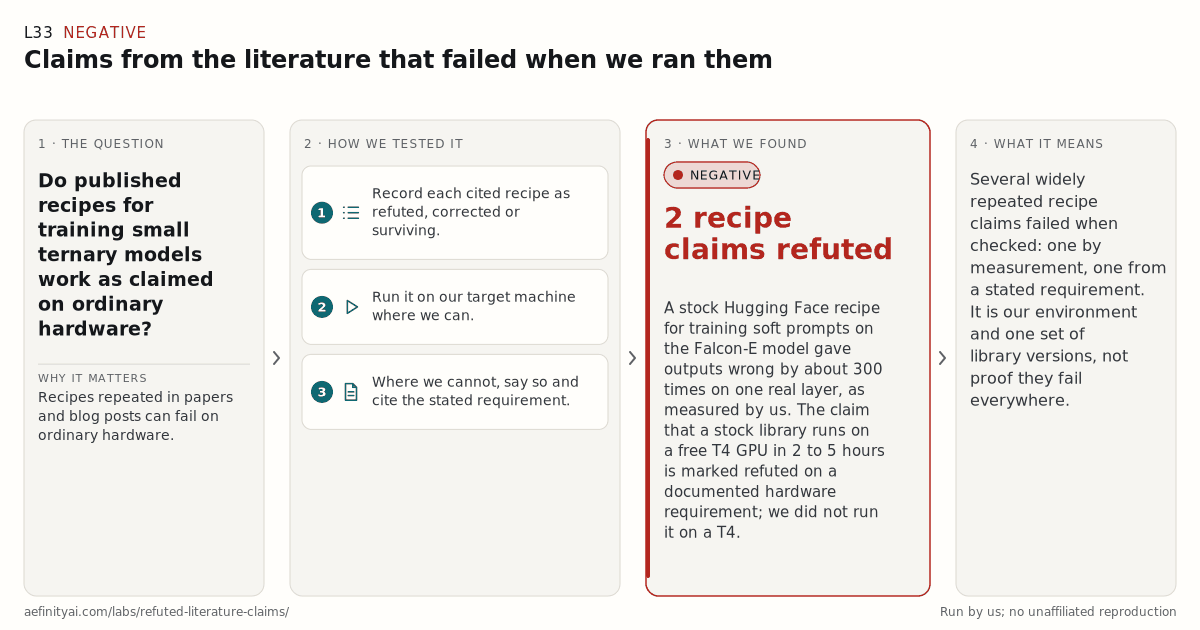
QuestionDo published recipes for training small ternary models work as claimed on ordinary hardware?
Run by us; no unaffiliated reproduction
The test in one picture
Question, method, result and meaning, in plain words. The sourced detail is further down the page.
The same picture, in words
- Question
- Do published recipes for training small ternary models work as claimed on ordinary hardware?
- Why it matters
- Recipes repeated in papers and blog posts can fail on ordinary hardware.
- How the test works
- Record each cited recipe as refuted, corrected or surviving.
- Run it on our target machine where we can.
- Where we cannot, say so and cite the stated requirement.
- What we found
- 2 recipe claims refuted. A stock Hugging Face recipe for training soft prompts on the Falcon-E model gave outputs wrong by about 300 times on one real layer, as measured by us. The claim that a stock library runs on a free T4 GPU in 2 to 5 hours is marked refuted on a documented hardware requirement; we did not run it on a T4.
- What it means
- Several widely repeated recipe claims failed when checked: one by measurement, one from a stated requirement. It is our environment and one set of library versions, not proof they fail everywhere.
- Where the facts come from
Share this picture: SVG · PNG (1200 x 630)

01Why it matters
Recipes repeated in papers and blog posts can fail on ordinary hardware.
02Method, step by step
- Record each cited recipe as refuted, corrected or surviving.
- Run it on our target box where we can.
- Where we cannot, say so and cite the requirement.
Method as recorded
Our research notes record each cited recipe as refuted, corrected or surviving. The soft-prompt recipe was refuted by execution on our own target machine. The T4 claim was refuted by reading the requirements stated in a cited source, and we did not run it on a T4. Run by us.
03Results, exact and sourced
-
R1A stock Hugging Face transformers recipe (AutoBitLinear, online_quant=False) for training soft prompts on the Falcon-E checkpoint gave outputs wrong by about 300 times on one real layer (layer-0 q_proj), as measured by us on our target box.
so the stock recipe's outputs are wrong by weight_scale^2 (~301.9x measured on real layer-0 q_proj)
Verbatim source alice-aegis / refuted_claims.md -
R2The claim that stock onebitllms runs on a free Kaggle/Colab T4 in 2-5 hours is marked REFUTED in our notes. The basis is a documented hardware requirement (Triton >=3.3 needs compute capability 8.0+, and the T4 is sm_75). We did not run it on a T4. The notes say the path may survive only in an unverified older-library environment.
Triton >=3.3 (bundled with torch >=2.7) requires NVIDIA CC 8.0+ and dropped Turing
Verbatim source alice-aegis / refuted_claims.md
04What it does NOT show
That the recipes fail everywhere. This is our environment and one set of library versions.
05Scope and caveats
- Our environment and one set of library versions.
- Entries are our own research notes made public.
- Run by us; no unaffiliated reproduction.
- The soft-prompt result is one measurement on one layer of one checkpoint (Falcon-E). The source says the recipe was salvaged in weaker form and requires a step-0 logit-parity gate.
- The T4 refutation rests on the documented requirement in a cited source, not on our own run. The source says the path survives only behind an UNVERIFIED torch<=2.6 / triton-3.2 / pinned-TRL environment.
- The source notes there is no independent replication of the soft-prompt path anywhere.
06Outcome
The claim or approach failed, or we retracted it.
07What we learned
Several widely repeated recipe claims failed when we checked them, so we keep a public list of what failed. For each claim, the list says whether we ran it ourselves or checked it against a source's stated requirements.
08Check it yourself
- alice-aegis / refuted_claims.mdhttps://github.com/Aefinity-AI/alice-aegis/blob/main/program/model-lab/refuted_claims.md
Read the notes (link above).