L01 Positive Q1 · Same bits on two computers
CIS-2: the same AI output, bit for bit, on different machines
QuestionCan two different computers produce the exact same AI output, bit for bit, from a written specification?
Archived research (2026-10), development paused. This lab belongs to the CIS-2 line of research.
Run by us; no unaffiliated reproduction
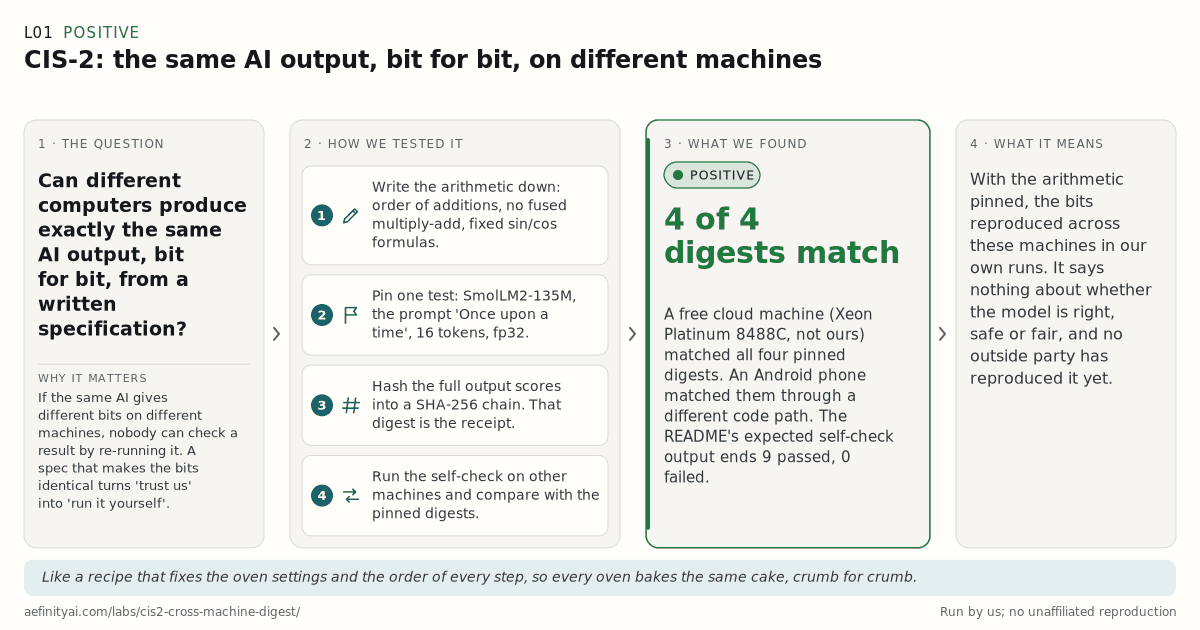
The test in one picture
Question, method, result and meaning, in plain words. The sourced detail is further down the page.
The same picture, in words
- Question
- Can different computers produce exactly the same AI output, bit for bit, from a written specification?
- Why it matters
- If the same AI gives different bits on different machines, nobody can check a result by re-running it. A spec that makes the bits identical turns 'trust us' into 'run it yourself'.
- How the test works
- Write the arithmetic down: order of additions, no fused multiply-add, fixed sin/cos formulas.
- Pin one test: SmolLM2-135M, the prompt 'Once upon a time', 16 tokens, fp32.
- Hash the full output scores into a SHA-256 chain. That digest is the receipt.
- Run the self-check on other machines and compare with the pinned digests.
- What we found
- 4 of 4 digests match. A free cloud machine (Xeon Platinum 8488C, not ours) matched all four pinned digests. An Android phone matched them through a different code path. The README's expected self-check output ends 9 passed, 0 failed.
- What it means
- With the arithmetic pinned, the bits reproduced across these machines in our own runs. It says nothing about whether the model is right, safe or fair, and no outside party has reproduced it yet.
- Everyday comparison
- Like a recipe that fixes the oven settings and the order of every step, so every oven bakes the same cake, crumb for crumb.
- Where the facts come from
Share this picture: SVG · PNG (1200 x 630)

01Why it matters
If an AI's output can differ depending on which computer ran it, nobody can audit a result by re-running it. A written specification that makes the bits identical would turn 'trust us' into 'run it yourself'.
02Method, step by step
- Write the arithmetic down: the order in which numbers are added, no fused multiply-add, how tiny numbers are flushed, the sin/cos polynomials and the position table.
- Pick one pinned test: the SmolLM2-135M model, the prompt 'Once upon a time', 16 greedy tokens, fp32.
- Hash the full output scores (the logits) into a SHA-256 chain. That digest is the receipt.
- Run the self-check on different machines and compare the digests with the pinned ones in EXPECTED_DIGESTS.md.
Method as recorded
Spec v0.3b pins the arithmetic (reduction order, no FMA, FTZ/DAZ, pinned polynomials, RoPE table); a SHA-256 witness chain over the full logits is the receipt. Public conformance vectors on Hugging Face. Pinned vector: SmolLM2-135M, prompt 'Once upon a time', 16 greedy tokens, fp32. The 9-check selfcheck.sh was run by the maintainer on own x86_64 machines (AVX2 and scalar; README machine table). On a free Lightning AI Studio (Xeon Platinum 8488C, 4 vCPU, AVX-512 flags, gcc 13.3.0, Ubuntu 24.04) only the narrower scripts/self_check.sh (four digests) was run, not selfcheck.sh. An aarch64 Android phone reproduced the pinned digests through the KV-cache verify3 path, not the self-check script. Run by us.
03Results, exact and sourced
-
R1A free Lightning AI cloud Studio (Xeon Platinum 8488C, CPU not owned by us) matched all four pinned digests using the narrower scripts/self_check.sh, not the 9-check selfcheck.sh. Driven by the maintainer.
**Result: PASS — all four digests match the pinned test vector.**
Verbatim source cis2-spec / 2026-09-25-LIGHTNING-STUDIO-SELFCHECK.md -
R2The README's documented expected selfcheck.sh output (shown with an i5-5200U fingerprint, the i5-5200U AVX2 row) ends in 9 passed, 0 failed. This is shown as expected output; the machine table separately lists the i5-5200U host with its log not published.
== SUMMARY: 9 passed, 0 failed ==
Verbatim source cis2-spec / README.md -
R3The aarch64 Android phone reproduced the pinned digests through a different code path; the self-check script itself was not run on it.
`selfcheck.sh` not run on the device; the pinned §13.1 digests were reproduced on it through the KV-cache `verify3/` path
Verbatim source cis2-spec / README.md
04What it does NOT show
That the model is right, safe or fair; that anything outside fp32 greedy decoding on one small model reproduces; or that an outside party gets the same result.
05Scope and caveats
- Run by us on every machine, including the cloud workspace; the README says: No unaffiliated party has reproduced it yet.
- One model (SmolLM2-135M), one prompt, 16 tokens, fp32 greedy decoding only (no sampling, batching or quantization), mostly CPU; production bf16/GPU serving is outside the spec today.
- Full logs for most machine-table rows are published as 'log not published'.
- The Lightning run used scripts/self_check.sh (four digests), not the 9-check selfcheck.sh; the 9-passed line is the README's expected-output block (i5-5200U fingerprint), not a separately published log.
- The Lightning Studio is a free tier workspace, not a rented one; no timing numbers reported.
- One machine-table host (one of our own machines) had weights copied over the LAN because its resolver could not reach the Hugging Face CDN; the pinned sha256 of all three artifacts was still verified.
- Shows the bits reproduce; says nothing about whether the model is correct, safe or fair.
- Conformance-suite internals are not public; only the vectors and spec are.
06Outcome
The check worked as expected, within the stated scope.
07What we learned
With the arithmetic pinned in writing, one fp32 digest reproduced across AVX2 and scalar x86, an aarch64 phone and an AVX-512-capable cloud CPU (generic build, self-check only), in our own runs. Until an outsider runs it, the claim stays 'reproduced by us'.
08Check it yourself
- cis2-spec / README.mdhttps://github.com/Aefinity-AI/cis2-spec/blob/main/README.md
- cis2-spec / EXPECTED_DIGESTS.mdhttps://github.com/Aefinity-AI/cis2-spec/blob/main/EXPECTED_DIGESTS.md
- cis2-spec / CIS2_SPEC_v0.3b.mdhttps://github.com/Aefinity-AI/cis2-spec/blob/main/docs/CIS2_SPEC_v0.3b.md
- cis2-spec / 2026-09-25-LIGHTNING-STUDIO-SELFCHECK.mdhttps://github.com/Aefinity-AI/cis2-spec/blob/main/docs/results/2026-09-25-LIGHTNING-STUDIO-SELFCHECK.md
- Hugging Face / cis2-conformancehttps://huggingface.co/datasets/aefinityAIINC/cis2-conformance
Reproduce the headline check with the command the repository README gives:
git clone https://github.com/Aefinity-AI/cis2-spec && cd cis2-spec && ./selfcheck.shThe README also lists a narrower local script, scripts/self_check.sh, run after the same git clone. The README says it needs a Rust toolchain (cargo) and network access to download the pinned SmolLM2-135M weights.