L09 Positive Q4 · Agent records and their cost
Ordinary logging versus replay-based receipts on one-field edits
QuestionIf someone edits one field in an AI agent's log, does the log show it?
Run by us; no unaffiliated reproduction
The test in one picture
Question, method, result and meaning, in plain words. The sourced detail is further down the page.
The same picture, in words
- Question
- If someone edits one field in an AI agent's log, does the log show it?
- Why it matters
- Logs are text. The question is whether a log can tell you it has been edited.
- How the test works
- Record one two-step tool-using episode.
- Make three single-field edits to the record.
- View each edit in the ordinary unverified display, then run the replay verifier.
- What we found
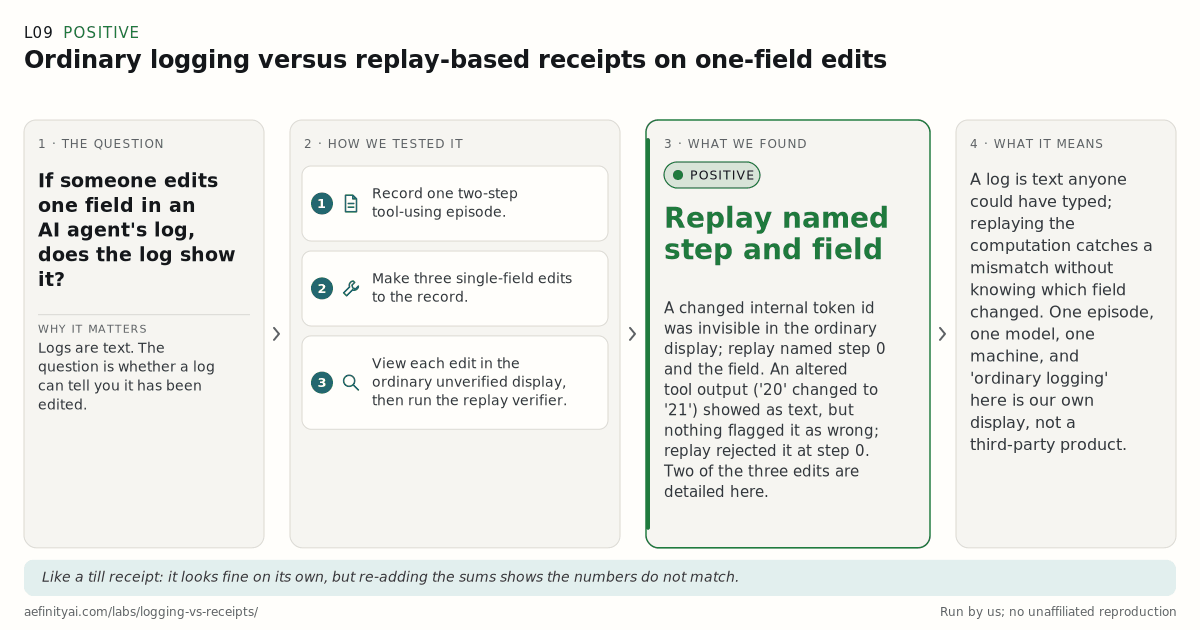
- Replay named step and field. A changed internal token id was invisible in the ordinary display; replay named step 0 and the field. An altered tool output ('20' changed to '21') showed as text, but nothing flagged it as wrong; replay rejected it at step 0. Two of the three edits are detailed here.
- What it means
- A log is text anyone could have typed; replaying the computation catches a mismatch without knowing which field changed. One episode, one model, one machine, and 'ordinary logging' here is our own display, not a third-party product.
- Everyday comparison
- Like a till receipt: it looks fine on its own, but re-adding the sums shows the numbers do not match.
- Where the facts come from
Share this picture: SVG · PNG (1200 x 630)

01Why it matters
Logs are text. The question is whether a log can tell you it has been edited.
02Method, step by step
- Record one two-step tool-using episode.
- Make three single-field edits to the record.
- Look at each in the receipt's own unverified display, then run the replay verifier.
Method as recorded
Three single-field mutations of one recorded two-step tool-using episode (pruned BitNet-2B, one host, 2026-09-22), each shown in the receipt's own unverified display and through the replay verifier. Run by us.
03Results, exact and sourced
-
R1A changed internal token id (one id, step 0) was invisible in the ordinary display, but replay named the step and the field.
(verifier line: step 0 divergence: toks-match=false tool-match=true in-match=true out-match=true decode-chain-match=true)
Verbatim source cis2-spec / RECEIPT-VS-LOGGING.md -
R2An altered tool output ('20' changed to '21') was rejected at step 0 by replay. In the ordinary display this change was visible as printed text, but nothing in the log format flagged it as wrong.
(verifier line: step 0 divergence: toks-match=true tool-match=true in-match=true out-match=false decode-chain-match=true)
Verbatim source cis2-spec / RECEIPT-VS-LOGGING.md
04What it does NOT show
Anything about third-party logging products; the 'ordinary logging' here is our own display. Three edits, one episode, one machine.
05Scope and caveats
- Three chosen mutations of one episode, one model, one machine; not adversarial.
- 'Ordinary logging' is our own unverified display, not a third-party logging product.
- The viewer only reformats the verifier's verdict; it is not independent evidence.
- Run by us; no unaffiliated reproduction.
- In the altered-tool-output case the ordinary display did show the changed value ('21'); the source's point is that the log format itself does not flag it.
- The source describes a third case, a flipped decode-chain digest bit, also caught at step 0 and invisible in the ordinary display. It is omitted from this entry's results.
- Model artifacts are referenced by hash only and are not checked into the public repo. The fixtures live in the alice-aegis repo, and this entry does not verify that repo is public.
06Outcome
The check worked as expected, within the stated scope.
07What we learned
A log is text anyone could have typed. Replaying the computation catches the mismatch without knowing in advance which field was changed.
08Check it yourself
- cis2-spec / RECEIPT-VS-LOGGING.mdhttps://github.com/Aefinity-AI/cis2-spec/blob/main/docs/results/RECEIPT-VS-LOGGING.md
Read the result page (link above).