L23 Mixed Q7 · No tuning after the fact
Our test standard and the public experiment ledger
QuestionHow can an outsider tell that a lab didn't tune its results after the fact, rewrite them later, or quietly drop the failures?
Run by us; no unaffiliated reproduction
The test in one picture
Question, method, result and meaning, in plain words. The sourced detail is further down the page.
The same picture, in words
- Question
- How can an outsider tell that a lab did not tune its results after the fact, rewrite them later, or quietly drop the failures?
- Why it matters
- Results are only as credible as the process behind them.
- How the test works
- Write the pass mark before the run.
- Publish a salted, hash-chained fingerprint of the private register.
- Number every defect as an erratum.
- Remove numbers that have no provenance.
- What we found
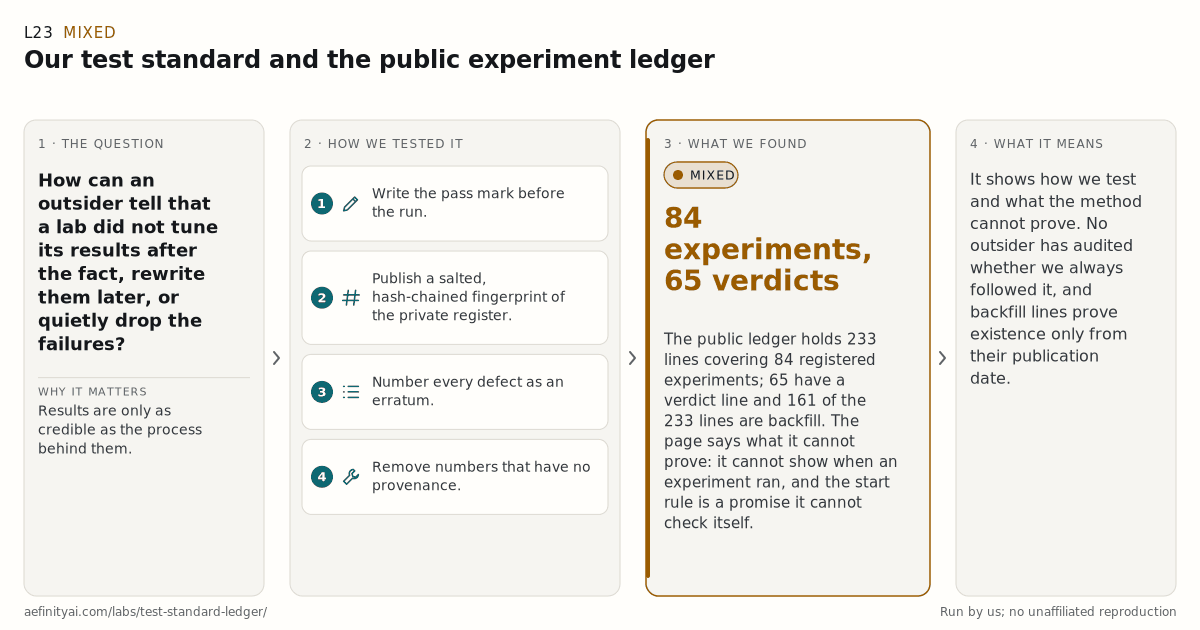
- 84 experiments, 65 verdicts. The public ledger holds 235 lines covering 84 registered experiments; 65 have a verdict line and 161 of the 235 lines are backfill. The page says what it cannot prove: it cannot show when an experiment ran, and the start rule is a promise it cannot check itself.
- What it means
- It shows how we test and what the method cannot prove. No outsider has audited whether we always followed it, and backfill lines prove existence only from their publication date.
- Where the facts come from
Share this picture: SVG · PNG (1200 x 630)

01Why it matters
Results are only as credible as the process behind them.
02Method, step by step
- Write the pass mark before the run.
- Publish a salted, hash-chained fingerprint of the private register.
- Number every defect as an erratum.
- Remove numbers that have no provenance.
Method as recorded
Stated practices in public files: (1) pre-registration, a pass mark written before the run, then a verdict; (2) a public salted, hash-chained fingerprint ledger of the private register, with a verify_ledger.py script and an OpenTimestamps proof file (LEDGER.tsv.ots); (3) no timing or throughput numbers in the spec repo; (4) provenance on every number; (5) defects recorded as numbered errata in CHANGELOG.md, and pinned digests do not move silently; (6) mismatches are welcomed as results. The standard is stated and applied by us, not audited by an outside party. All six URLs returned HTTP 200 unauthenticated (github.com and raw.githubusercontent.com) on 2026-10-12.
03Results, exact and sourced
-
R1The ledger covers 84 registered experiments, 65 with a verdict; 161 of 235 lines are backfill (ledger/README.md as of 2026-10-15).
At the time of this export the ledger holds 235 lines. They cover 84 registered experiments, and 65 of them have a verdict line. 161 of the 235 lines are marked backfill.
Verbatim source cis2-spec / README.md -
R2The ledger states what it cannot prove.
It cannot show when an experiment ran. A lab could run an experiment in private, look at the result, and then publish a pass mark.
Verbatim source cis2-spec / README.md -
R3The start rule is a promise the page itself cannot check.
That rule is a promise. This page cannot check it.
Verbatim source cis2-spec / README.md -
R4Provenance on every number, or the number is removed.
A number with no provenance gets removed rather than trusted.
Verbatim source cis2-spec / CONTRIBUTING.md -
R5Pinned digests do not move silently.
The rule is that goldens do not move silently: if an erratum changes a pinned digest, the change, the cause and the new value all land in the same commit as the version bump.
Verbatim source cis2-spec / CONTRIBUTING.md -
R6No unqualified superlatives.
**No unqualified superlatives.**
Verbatim source cis2-spec / CONTRIBUTING.md -
R7A mismatch is a result.
Open the PR whether your digests match or not. A mismatch is a result.
Verbatim source cis2-spec / CONTRIBUTING.md
04What it does NOT show
That we always followed the standard; no outsider has audited it.
05Scope and caveats
- Stated and applied by us; no unaffiliated audit of whether practice always matched the statement.
- 161 of 235 ledger lines are backfill and prove existence only from their publication date; backfill lines show no order of writing.
- The ledger shows counts and line kinds, not what was tested or found.
- The ledger count is a snapshot and will grow.
- The ledger cannot show when an experiment ran; the rule that a run starts only after its bar line is public applies from the day of publication on, with exceptions marked start-unanchored.
- The ledger chain verification was not re-run by this verifier; the earlier claim of an unauthenticated-clone verification is removed from the method text.
06Outcome
Some parts held, some did not, or we corrected ourselves.
07What we learned
We publish how we test, including what the method cannot prove, and we correct our own published claims through numbered errata.
08Check it yourself
- cis2-spec / README.mdhttps://github.com/Aefinity-AI/cis2-spec/blob/main/ledger/README.md
- cis2-spec / LEDGER.tsvhttps://github.com/Aefinity-AI/cis2-spec/blob/main/ledger/LEDGER.tsv
- cis2-spec / verify_ledger.pyhttps://github.com/Aefinity-AI/cis2-spec/blob/main/ledger/verify_ledger.py
- cis2-spec / CONTRIBUTING.mdhttps://github.com/Aefinity-AI/cis2-spec/blob/main/CONTRIBUTING.md
- cis2-spec / CHANGELOG.mdhttps://github.com/Aefinity-AI/cis2-spec/blob/main/CHANGELOG.md
- cis2-spec / E15m_PREREG.mdhttps://github.com/Aefinity-AI/cis2-spec/blob/main/docs/E15m_PREREG.md
Read the ledger README, LEDGER.tsv and verify_ledger.py, then CONTRIBUTING.md and CHANGELOG.md (links above). We did not re-run the chain verification for this page.