L26 Undated in the source Mixed Q9 · Shrinking models
RANGER Phase 1: the quantization ideas on real models (SmolLM2-135M, Qwen3-0.6B)
QuestionDo those shrinking tricks survive on real pretrained models, and was our earlier null result even valid?
Run by us; no unaffiliated reproduction
The test in one picture
Question, method, result and meaning, in plain words. The sourced detail is further down the page.
The same picture, in words
- Question
- Do those shrinking tricks survive on real pretrained models, and was our earlier null result even valid?
- Why it matters
- Synthetic results do not count until they survive on real models.
- How the test works
- Measure perplexity on a WikiText-2 slice for SmolLM2-135M; replicate on Qwen3-0.6B.
- Fix predictions and kill gates before each run; claim effects only above 3x run noise.
- Re-test small effects on disjoint slices.
- What we found
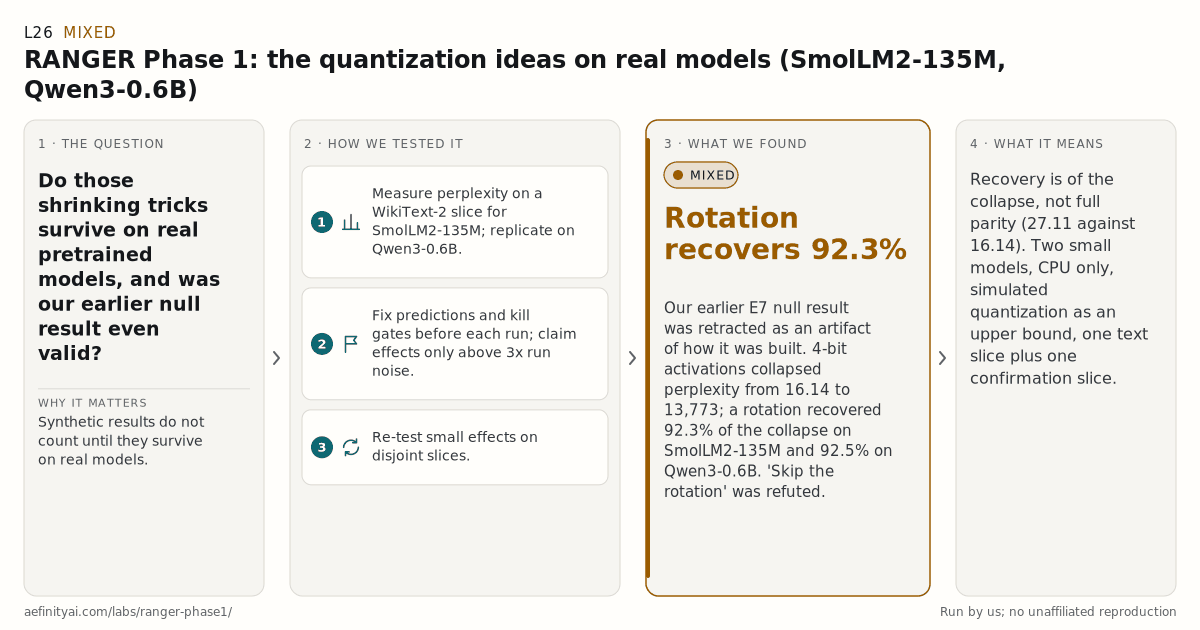
- Rotation recovers 92.3%. Our earlier E7 null result was retracted as an artifact of how it was built. 4-bit activations collapsed perplexity from 16.14 to 13,773; a rotation recovered 92.3% of the collapse on SmolLM2-135M and 92.5% on Qwen3-0.6B. 'Skip the rotation' was refuted.
- What it means
- Recovery is of the collapse, not full parity (27.11 against 16.14). Two small models, CPU only, simulated quantization as an upper bound, one text slice plus one confirmation slice.
- Where the facts come from
Share this picture: SVG · PNG (1200 x 630)

01Why it matters
Synthetic results do not count until they survive on real models.
02Method, step by step
- Measure perplexity on a WikiText-2 slice for SmolLM2-135M, replicate on Qwen3-0.6B.
- Fix predictions and kill gates before each run; claim effects only above 3x run noise.
- Re-test small effects on disjoint slices.
Method as recorded
Teacher-forced perplexity on non-overlapping ctx-1024 windows of a 16,384-token WikiText-2 slice (SmolLM2-135M); Qwen3-0.6B replication at 8,192 tokens, ctx 512, so only within-model deltas compare. CPU-only 6 GB VM. Predictions and kill gates fixed before each run; effects claimed only above 3x the ~0.05 PPL run noise. A confirmation pass on disjoint slices re-tested the small effects. Run by us.
03Results, exact and sourced
-
R1Our earlier E7 null result was retracted as an artifact of how it was built; nothing about super-weight protection can be concluded from E7.
E7's null result was an artifact by construction — retract it.
Verbatim source ranger / RESULTS-phase1.md -
R2On SmolLM2-135M (fp32), 4-bit per-token activation quantization collapses perplexity from 16.14 to 13,773; a folded rotation sandwich recovers 92.3% of the log-PPL collapse, leaving PPL at 27.11 (still above the 16.14 baseline). On Qwen3-0.6B the recovery was 92.5% (34.23 to 146,845 collapse). Fake-quant is an upper bound on deployable A4.
A4 per-token quantization collapses PPL 16.14 → 13,773; a per-linear folded rotation sandwich recovers **92.3%** of the log-PPL collapse (→ 27.11)
Verbatim source ranger / RESULTS-phase1.md -
R3Refuted: the 'skip the rotation' upgrade. Static exemption of 8 census channels recovered only 59.1% at 135M (25% with activation-measured channels at 0.6B; the census-derived set did nothing on Qwen) versus 92%+ for rotation.
Pillar 1's "skip the rotation" upgrade is refuted
Verbatim source ranger / RESULTS-phase1.md -
R4Null at 135M: no super-weight lever over an honest g=128 4-bit baseline, and MSE clipping hurts there (24.896 to 26.917). The 'rescues 0.38 of clip damage' sub-result was refuted as noise on a disjoint slice (-0.015). At 0.6B, clipping helps (48.06 to 41.82) and the coordinate increment is small but real (+0.45, then +0.24).
At 135M there is no exploitable super-weight lever over an honest W4 baseline — and MSE-clipping actively hurts.
Verbatim source ranger / RESULTS-phase1.md -
R5Across models, the overlap between the weight census and activation-outlier channels fell from 6/10 (SmolLM2-135M) to 2/10 (Qwen3-0.6B); the census still found the single top channel on both.
Census→activation overlap collapses: 6/10 → 2/10.
Verbatim source ranger / RESULTS-phase1.md
04What it does NOT show
Parity with the unquantized model (recovery is of the collapse, not full parity), larger models, or deployable int4 (fake-quant is an upper bound).
05Scope and caveats
- Two small models, CPU-only, one WikiText-2 slice (plus one disjoint confirmation slice each); Qwen absolute perplexity is chat-tuned (34.23 bf16) and not comparable to SmolLM2; slice-to-slice magnitude varies a lot, direction is the replicated quantity.
- Per-token dynamic fake-quant upper-bounds deployable 4-bit activations; rotation used a QR orthogonal, not a fast Hadamard; Qwen rotation arm ran in bf16 with storeback rounding noted.
- Super-weight effects are documented in the literature from about 1B parameters up; scale-gated pending larger runs.
- Rotation sandwich W4A4 end-to-end point is 53.868 PPL vs 16.14 baseline: recovery is of the collapse, not full parity.
- The source document describes itself with a superlative ordinal; we do not repeat that wording.
- Run by us; no unaffiliated reproduction.
06Outcome
Some parts held, some did not, or we corrected ourselves.
07What we learned
A prior null result was retracted publicly. Rotation recovery replicated across two architectures (92.3% and 92.5%), while the census-replaces-rotation shortcut was refuted, and a super-weight lever is null at 135M and only small at 0.6B. One of our own sub-results (0.38 rescue) was refuted by our confirmation pass.
08Check it yourself
- ranger / RESULTS-phase1.mdhttps://github.com/Aefinity-AI/ranger/blob/main/research/phase1/RESULTS-phase1.md
Read the results file (link above).