L27 Negative Q8 · Speed numbers
Retraction: our benchmark laptop was running at about one fifth speed
QuestionWere our speed measurements measuring our code, or a hidden hardware throttle?
Run by us; no unaffiliated reproduction
The test in one picture
Question, method, result and meaning, in plain words. The sourced detail is further down the page.
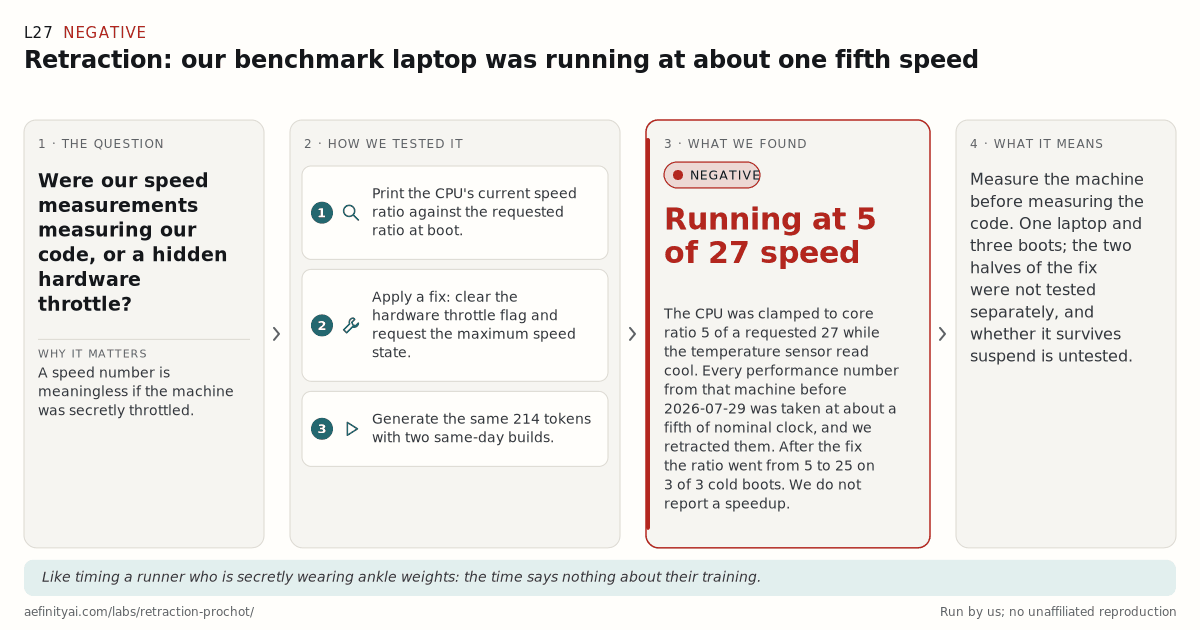
The same picture, in words
- Question
- Were our speed measurements measuring our code, or a hidden hardware throttle?
- Why it matters
- A speed number is meaningless if the machine was secretly throttled.
- How the test works
- Print the CPU's current speed ratio against the requested ratio at boot.
- Apply a fix: clear the hardware throttle flag and request the maximum speed state.
- Generate the same 214 tokens with two same-day builds.
- What we found
- Running at 5 of 27 speed. The CPU was clamped to core ratio 5 of a requested 27 while the temperature sensor read cool. Every performance number from that machine before 2026-07-29 was taken at about a fifth of nominal clock, and we retracted them. After the fix the ratio went from 5 to 25 on 3 of 3 cold boots. We do not report a speedup.
- What it means
- Measure the machine before measuring the code. One laptop and three boots; the two halves of the fix were not tested separately, and whether it survives suspend is untested.
- Everyday comparison
- Like timing a runner who is secretly wearing ankle weights: the time says nothing about their training.
- Where the facts come from
Share this picture: SVG · PNG (1200 x 630)

01Why it matters
A speed number is meaningless if the machine was secretly throttled.
02Method, step by step
- Print the current core ratio against the requested ratio at boot.
- Apply a fix, clearing bd-PROCHOT and requesting the maximum P-state.
- Generate the same 214 tokens with two same-day builds.
Method as recorded
A boot-time diagnostic printed the current core ratio against the requested ratio on a Dell Inspiron 15 (i5-5200U, bare metal, no OS). Two builds made the same day, differing only by the STAGE 7 fix (clear bd-PROCHOT and request max P-state), generated the same 214 tokens with a 14.17M-parameter model. Run by us.
03Results, exact and sourced
-
R1The CPU was clamped to ratio 5 of a requested 27, with PROCHOT asserted while the thermal sensor read cool.
was clamped to core ratio 5 out of a requested 27.
Verbatim source alice-aegis / 2026-08-05_bd-prochot-benchmark-lie.md -
R2Every earlier number from that box (before 2026-07-29) was taken at roughly a fifth of nominal clock, and was retracted.
Every performance number we took on that box before 2026-07-29 was measured on a CPU
Verbatim source alice-aegis / 2026-08-05_bd-prochot-benchmark-lie.md -
R3After the fix, cur_ratio went from 5 to 25 on 3 of 3 cold boots (one machine).
Reproduced on 3/3 cold boots.
Verbatim source alice-aegis / 2026-08-05_bd-prochot-benchmark-lie.md -
R4Wall-time ratio across the two same-day builds was 3.861x, below the 5.000x the ratio change implies; output was byte-identical. Not reported as a speedup.
We are deliberately not reporting this as a speedup.
Verbatim source alice-aegis / 2026-08-05_bd-prochot-benchmark-lie.md -
R5Published as a retraction.
this post is a retraction, not a speedup
Verbatim source alice-aegis / 2026-08-05_bd-prochot-benchmark-lie.md -
R6Limitation of the before/after: no clear-only arm.
No clear-only arm.
Verbatim source alice-aegis / 2026-08-05_bd-prochot-benchmark-lie.md
04What it does NOT show
A speed-up, durability across suspend, or the effect of each half of the fix, since there was no clear-only arm.
05Scope and caveats
- One machine (n=1 laptop, 3 cold boots); run by us; no unaffiliated reproduction.
- The fix (MSR 0x1FC bit 0) is about fifteen years old; the post cites prior art and does not claim it as new. The measurement error is the point.
- The fix stage changed two things at once (cleared bd-PROCHOT and requested the maximum P-state); no clear-only arm was run, so the ordering hypothesis is untested.
- Durability is untested: unknown whether the clear survives S3 suspend or an EC re-assert after a firmware event.
- The 3.861x vs 5.000x gap is described as a crude indicator of memory-bound work, not a measured decomposition.
- The post's tok/s column is too coarse to quote; tick counts are the instrument.
06Outcome
The claim or approach failed, or we retracted it.
07What we learned
Measure the machine before measuring the code. We retracted every earlier number from that box instead of reporting a speed-up.
08Check it yourself
- alice-aegis / 2026-08-05_bd-prochot-benchmark-lie.mdhttps://github.com/Aefinity-AI/alice-aegis/blob/main/docs/posts/2026-08-05_bd-prochot-benchmark-lie.md
Read the post (link above).